

From uncertain adolescent to youth leader: Toha’s story
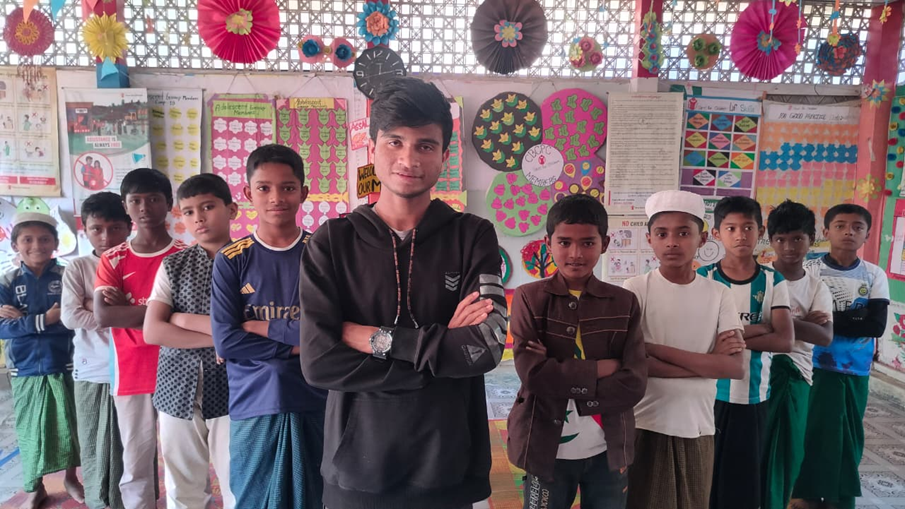
Above: Toha in the classroom, where he shares the importance of respect, dignity and protection with students. Photo: Rashna Sharmin Keya/Save the Children
In the narrow, dusty pathways of a Rohingya refugee camp in Cox’s Bazar lives a quiet 18-year-old named Toha*.
Two years ago, Toha stood at a crossroads, surrounded by uncertainty, limited opportunities, and the invisible weight of displacement. Like many adolescents in the world’s largest refugee camp, he faced a future clouded with questions.
“Who will I become? Will I ever be more than my circumstances?’’
“I did not know about child rights or protection before. I only knew fear and silence. But inside my heart, I wanted to grow and protect others like me,” Toha said.
In August 2023, everything began to change.
When Save the Children introduced structured adolescent programs in the camp, Toha was hesitant. He walked into his first Adolescent Group meeting nervously, eyes lowered. Yet, inside that small learning space, something powerful was planted. Month after month, he returned. Slowly, the shy boy transformed into an active learner, absorbing lessons on life skills, protective behaviour, leadership, and personal safety.
“Save the Children taught me about child rights, personal safety, and how to say ‘no’ to harmful practices,” Toha said. “They showed me that every child deserves protection, even in a camp.”
The journey was not easy. During Interactive Popular Theatre (IPT) sessions, Toha was asked to perform in front of others. His heart raced and his hands trembled. Standing on that small stage, he felt exposed and afraid. But with encouragement from facilitators and peers, he took a deep breath and spoke. That moment became a turning point. Through theatre, he learned to raise awareness about child labour, early marriage, violence, neglect, and exploitation.
“When I spoke on stage about abuse and child labour, I felt powerful. I realised my voice could prevent harm and protect children who cannot speak for themselves,” he said.
With every activity and event, Toha’s confidence grew. He began leading adolescent initiatives, organising awareness sessions and events, and supporting younger participants. The boy who once listened quietly was now guiding others.
“Now I can identify risks in my community. When I see violence, neglect, or unsafe behavior, I know how to respond and where to report. This knowledge gives me strength,” Toha said.
Toha applied for a Co-Facilitator position and faced a difficult test. He prepared tirelessly, carrying the dream of serving his community. When the results were announced, he learned that although he performed well, he could not be recruited due to placement limitations.
But Toha refused to give up. Today, he proudly serves as a teacher at the Youth Power for Social Action (YPSA) Learning Centre, which is supported by the Australian Government through the Australian Humanitarian Partnership. Every day, he stands in front of children who remind him of his younger self: uncertain, vulnerable, yet full of potential.
“In my classroom, I teach children not only reading and writing. I teach them about safety, respect, and dignity. I want every child to feel protected,” he says with conviction.
The transformation has also changed life at home. His family now listens to his opinions. They trust his decisions. They see him not as a boy anymore, but as a responsible young leader. In the wider community, parents point to Toha as an example of what guidance and opportunity can achieve.
Today, Toha actively raises awareness about child labour, trafficking, sexual harassment, early marriage, neglect, violence, discrimination, and exploitation. He supports peers in reporting protection concerns and encourages families to choose safe and positive parenting practices.
“Save the Children not only gave me training. They gave me protection, knowledge, confidence, and responsibility. Because of them, I am not only protecting myself, but I am protecting other children too,” he said.
These activities were supported by the Australian Government through the Australian Humanitarian Partnership.
*name changed