

Finding a place for Somir in the classroom
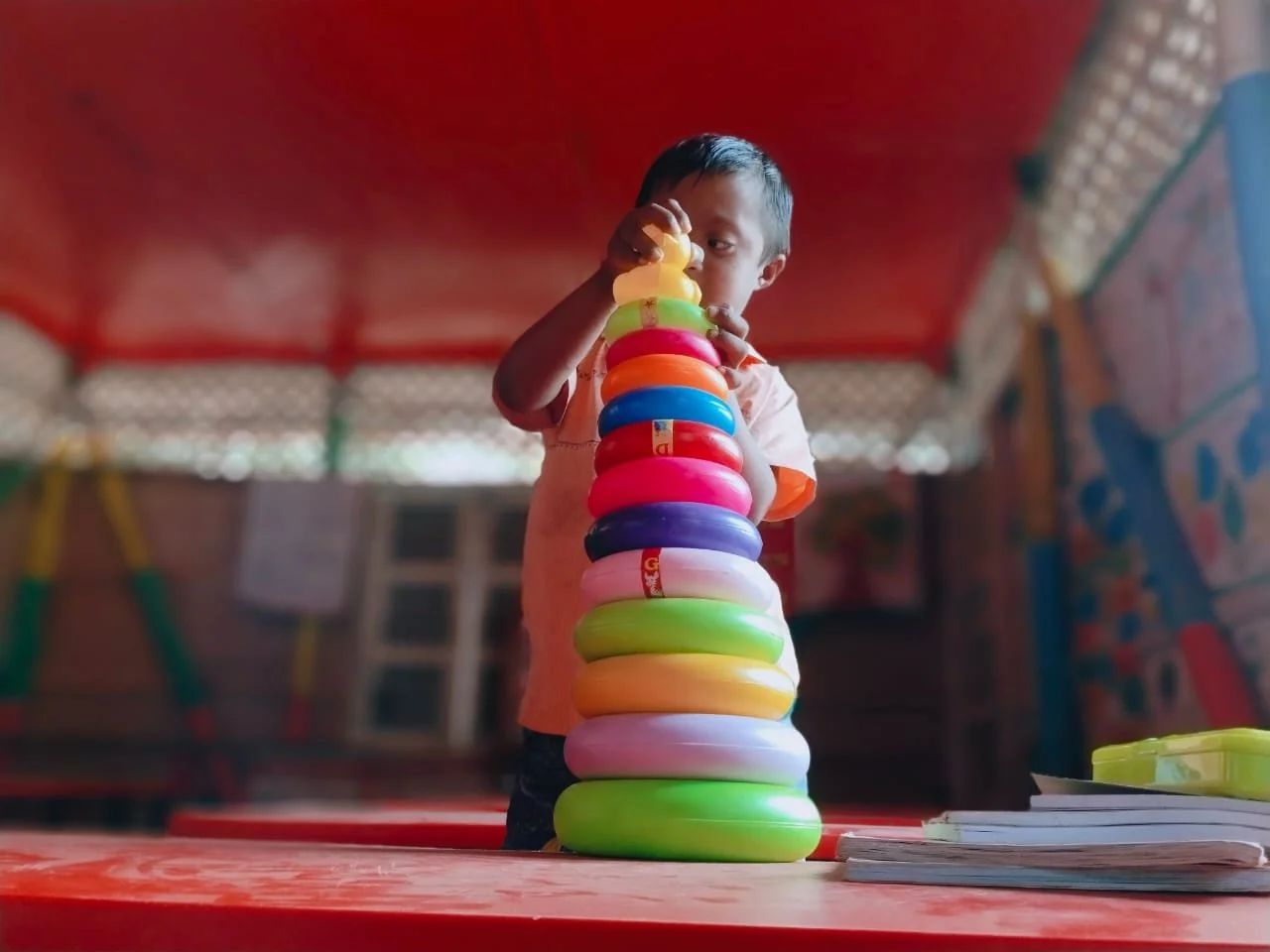
Above: Five-year-old Samir has Down syndrome, but inclusive education efforts by Save the Children and partners have created space and understanding for him in the classroom, where his skills and confidence have grown. Photo: Azad Ahmed/Save the Children
“Iba aar zaiga!” (This is my place!), declared five-year-old Somir*, proudly pointing at a chair just as the Camp-in-Charge was about to sit down during a visit to his Learning Center. For a brief second, the room froze. Then the Camp-in-Charge smiled and stepped back. Gentle laughter filled the classroom. Somir beamed. In that moment, he wasn’t just another child sitting quietly at the back, he was confident, visible, and happy.
But his confidence has not come easily.
Somir was born into hardship in the overcrowded Rohingya refugee camps in Cox’s Bazar, Bangladesh. The fifth child in his family, he grew up in a shelter where space was tight and worries were constant. From an early age, his mother sensed something was different.
“He was slower than the other children,” she said quietly. “He didn’t speak like them. Sometimes he didn’t understand what we were saying.”
Worried, Somir’s parents took him to Kabiraj (traditional healers), hoping something would change. When nothing did, they stopped trying.
“We thought this is how Allah made him,” his mother said. “So, we kept him close to home. We were afraid for him outside.”
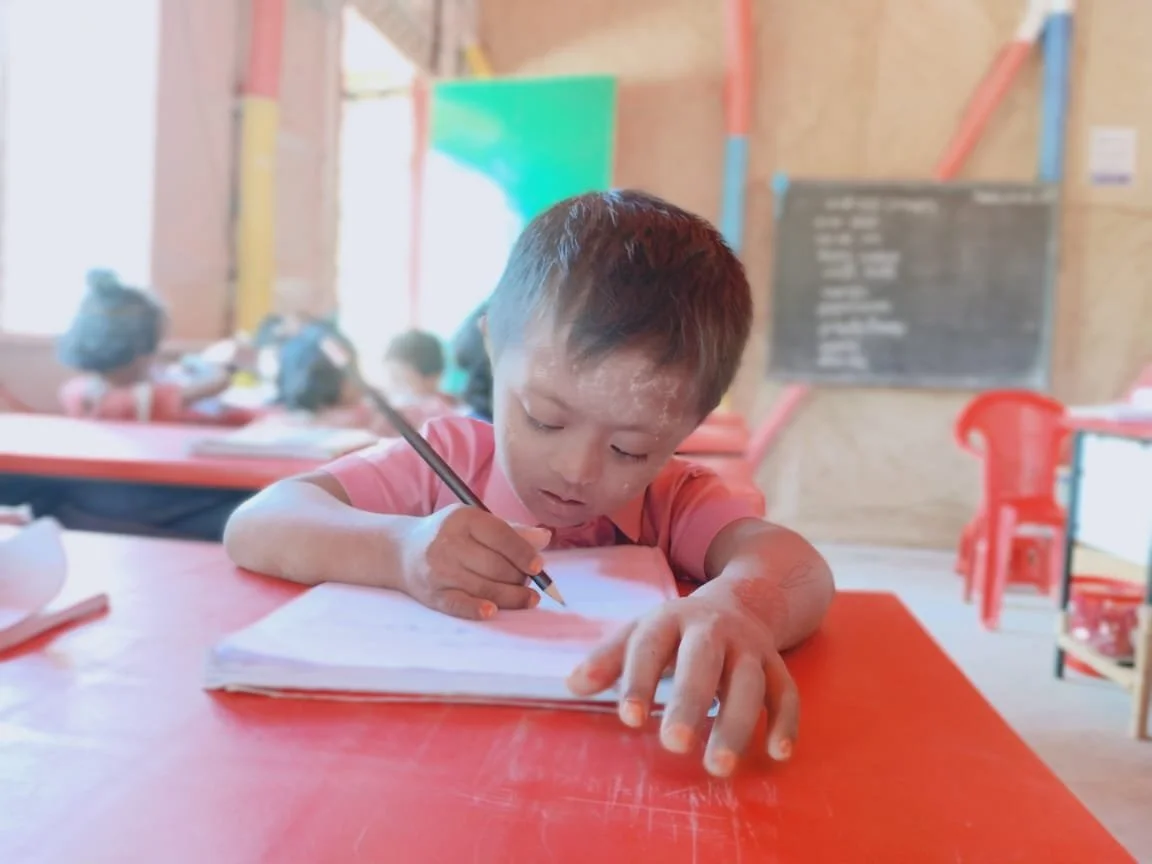
Above: Somir at his desk in his classroom in Cox’s Bazar, Bangladesh. Photo: Azad Ahmed/Save the Children
Gradually, Somir’s world became smaller, limited to his home and the narrow paths around their shelter.
Earlier this year, at the start of the new academic term, Save the Children conducted a large-scale survey using the Child Functioning Module (CFM) to identify children with disabilities for enrolment in Grade 1. That was when Somir was identified. He was later referred to Save the Children’s partner, Centre for Disability in Development (CDD), where he was diagnosed with Down syndrome.
When Rohingya teaching volunteer Hassan visited Somir’s family and suggested enrolling him in the Learning Center, fear filled the room.
“He cannot speak clearly… he doesn’t understand well… will he really be able to learn?” his parents asked. They shared their daily struggles, how Somir often got lost, how he sometimes picked up others’ belongings without understanding, and how complaints from neighbors left them ashamed and worried.
Hassan listened patiently. He explained Save the Children’s approach to inclusive education, which includes developed Individual Education Plans (IEP), regular follow-ups, classroom support for students, and guidance from CDD volunteers. Slowly, trust began to build. With hesitation and hope mixed together, Somir’s parents agreed to let their son attend class.
The first months were hard.
Somir sat quietly in the classroom, his big curious eyes moving from face to face, unsure where he belonged. “He was shy and confused,” Hassan recalls. Other learners teased him. They laughed when he tried to speak. Sometimes Hassan had to hold his hand and bring him Somir to the Learning Centre to attend class. The little boy’s hygiene awareness was poor, and his confidence almost nonexistent.
But Hassan did not give up.
Alongside supporting Somir, he worked patiently with the other learners, talking about respect, kindness, and inclusion. He also spent time with Somir’s parents, helping them understand that Down syndrome is not caused by myths or superstition, but is a developmental condition that needs care, understanding, and dignity. Change came slowly, but it came.
Somir began to smile more. He started sitting with other learners. He clapped when others clapped. He laughed when they laughed. When he spoke and his words came out differently, the laughter around him slowly changed, from mockery to shared joy.
Friendship replaced fear.
Today, Somir walks to the Learning Center on his own. He no longer gets lost. He comes to the front of the class to write. He can pronounce some letters, follow instructions, and insists on participating. His classmates cheer him on. He greets others, sits properly, and tries every single day.
The boy who once had no place in the classroom now points to his chair and proudly says, “This is my place.”
This activity was supported by the Australian Government through the Australian Humanitarian Partnership.
*Names changed