

From hunger to harvest

Above: Through Disaster READY, CARE’s Naomi leads a group discussion on strengthening the Village Savings and Loan Association, with Folkio and other women from her village. IMAGE: Jacklyn Yala/CARE in PNG
By Jacklyn Yala, Communications Coordinator, CARE in PNG
Fokilo Timo, a resilient widow and mother of six from Nagamito Village, embraced the opportunities presented through the Australian Humanitarian Partnership’s Disaster READY Program when she eagerly joined the Village Savings and Loan Association (VSLA), determined to improve her family’s situation.
Before CARE's arrival in her community, Fokilo's family primarily relied on sweet potato and cassava for sustenance. During the dry season, cassava was often the only available food source. Prepared solely by boiling, the monotonous diet led to complaints from her children. As a widow, Fokilo faced the immense challenge of providing for her six children with limited options and no stable income apart from selling garden produce, Life was a constant struggle.
However, CARE's introduction to the Nagamito community brought a beacon of hope. Fokilo actively participated in the training sessions, which covered vital skills such as food processing and preservation, disaster risk management, and the VSLA concept. These were entirely new concepts for Fokilo, who had never imagined preserving food for extended periods. She learned that crops like cassava, which typically spoiled within three days, could be preserved alongside bananas and sweet potatoes using new techniques. More importantly, Fokilo was empowered to turn these skills into income-generating opportunities. She learned how to bake cassava, banana, and sweet potato flour. Inspired, Fokilo invested in a 10kg bag of regular flour and began experimenting with mixing it with the processed cassava flour to feed her children. The results were a resounding success. Her children delighted in the new breakfast and lunch options, reporting that the flour-based meals kept them feeling full for longer. Seeing her children happy brought immense joy to Fokilo.
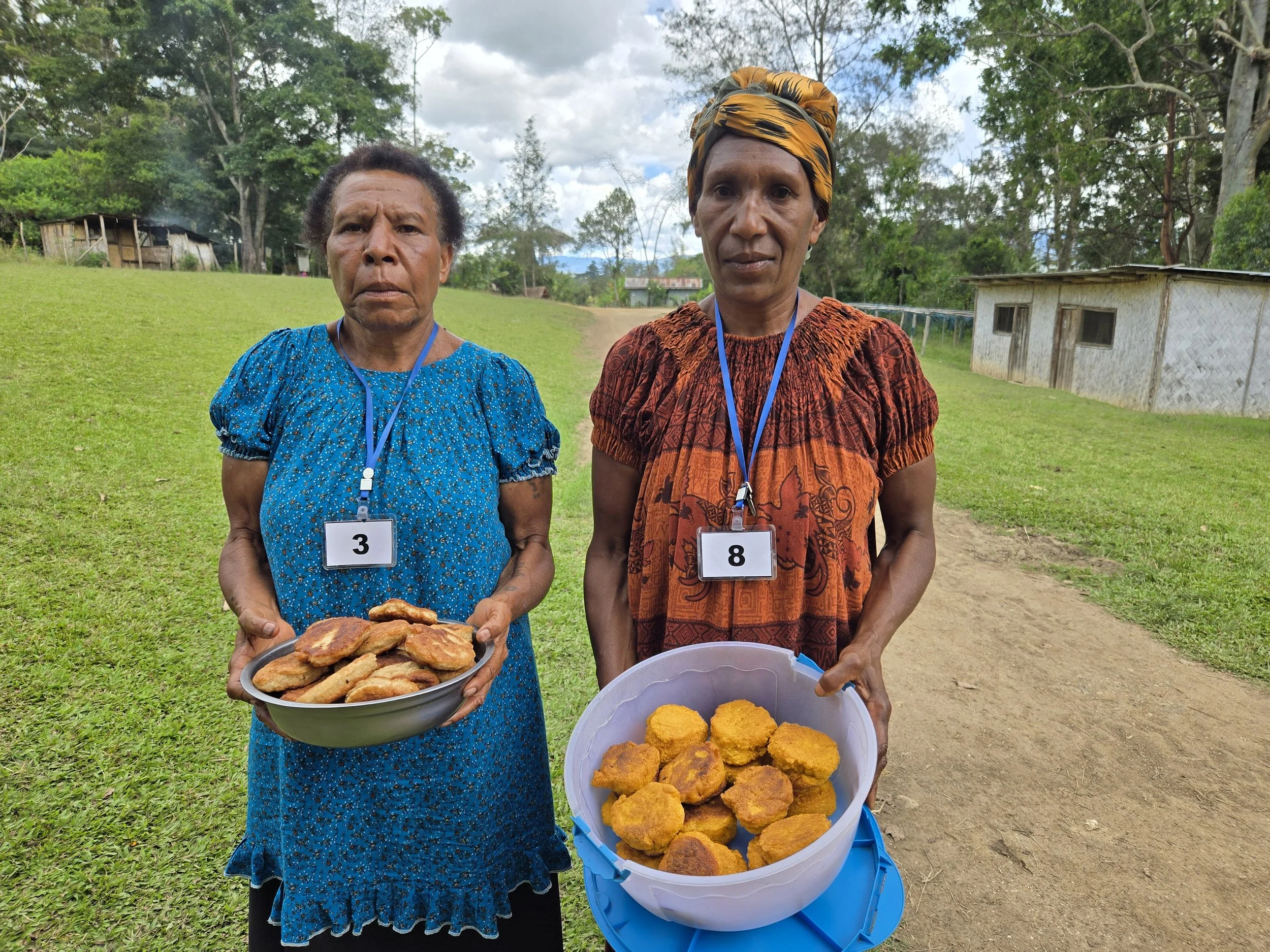
Above: Folkio (left) proudly shows some of the delicious treats she’s now baking, with thanks to support through the Disaster READY program. She says, “"I see a significant improvement in my life. I'm seeing big change, the flour bag I bought from the store lasts long, and I'm making enough money to repay my loan and have extra funds to meet my children’s needs.”. IMAGE: Jacklyn Yala/CARE in PNG
Recognizing the potential, Fokilo expanded her efforts to bake and sell the flour, generating much-needed income for her family. This newfound financial stability allowed her to purchase household necessities, significantly improving their quality of life. "This had improved my life unlike in the past, and I'm so happy that CARE has introduced these training in my community," she shares with heartfelt appreciation.
The VSLA further amplified Fokilo's success. With her initial savings, she secured a loan and purchased a 25kg bag of flour, which she continues to mix with processed cassava, banana, and sweet potato to bake flour balls. Remarkably, this single bag of flour has lasted her two and a half months, demonstrating the effectiveness of her new skills and financial management. "I have made a lot of money," Fokilo exclaims, "I see a significant improvement in my life. I'm seeing big change, the flour bag I bought from the store lasts long, and I'm making enough money to repay my loan and have extra funds to meet my children’s needs”
The food preservation techniques have also had a dramatic impact on reducing food waste. Fokilo now observes that her cassava and sweet potatoes last for up to six months, a stark contrast to the previous one-day shelf life of unprocessed cassava. She has even seen preserved produce remain fresh in storage for nearly a year. Eager to share her knowledge, Fokilo has demonstrated these methods to visiting relatives.
"Our ancestors didn't even understand the food preservation methods. Passing on from generations, in our community, during the dry season, we go without food/hungry, and now CARE has introduced a life-saving skill. Now, my children and I won't be hungry when the dry season comes; we still have our flour to eat."
The impact extends beyond her immediate family. Fokilo notes that the need for arduous journeys to neighboring villages to purchase sweet potatoes during the dry season has ceased. The ability to preserve their own food has provided a reliable food source and has even enabled her to meet customary obligations within the village. "This skill has also helped me fulfill important cultural responsibilities in the village.” she concludes.
Fokilo's story is testament to the transformative impact of knowledge and support. From a life of limited options and food insecurity, she has embraced new skills, built a small business, secured her family's food supply, and achieved financial stability. Her journey exemplifies resilience, resourcefulness, and the profound difference that community-based development programs can make in the lives of vulnerable individuals and their families.