

Community action builds resilience
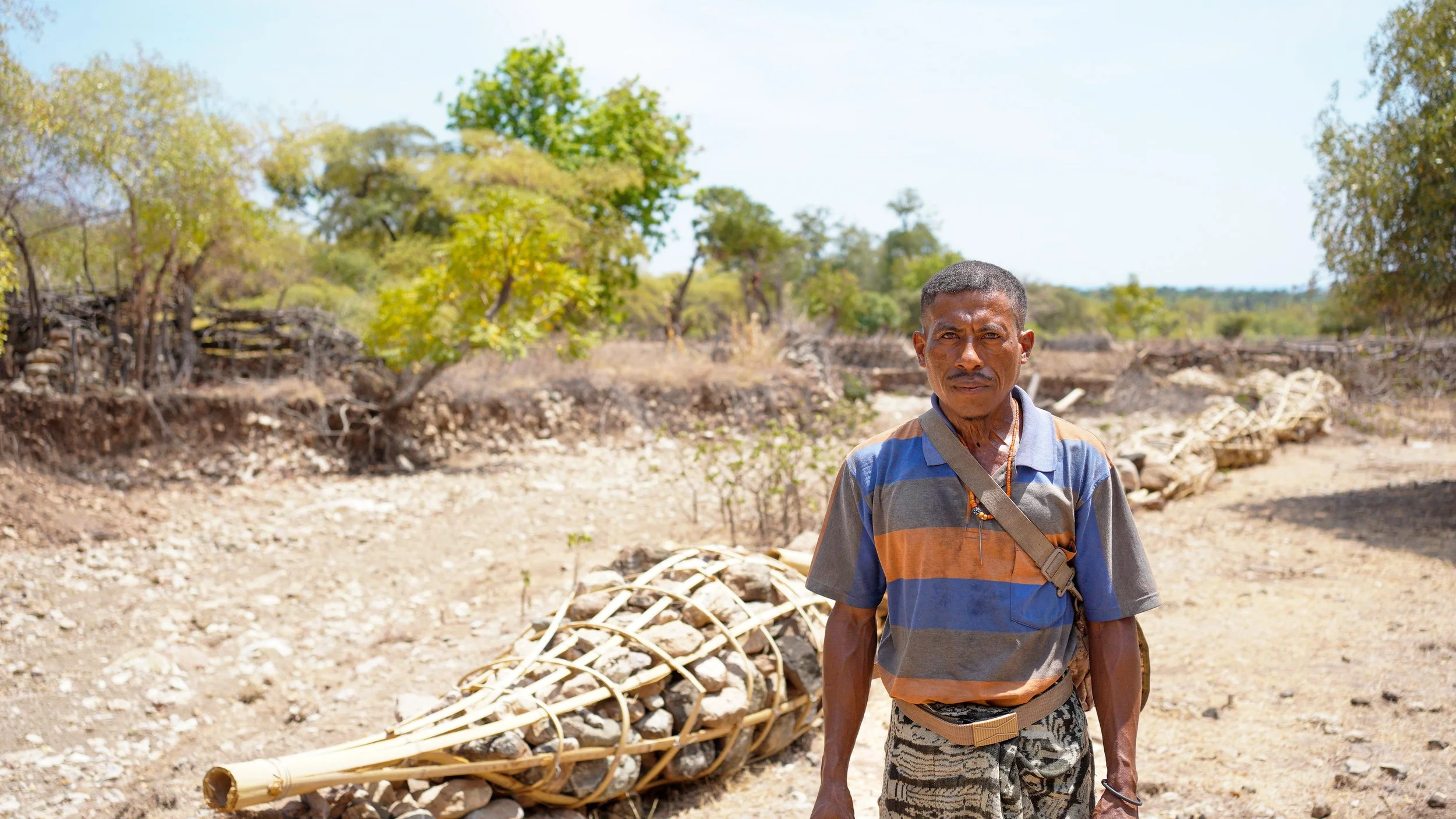
“When we build gabions, we protect our farms. When we conserve water and plant trees, we protect our future. This project has brought real change. We are no longer afraid of the floods. We have water to drink, trees to protect our soil, and savings to support our families. All we need now is to keep working together.” Agustinho said, after his community received support from the Disaster READY program.
IMAGE: Aderito do Rosario da Cunha Mambares
By Aderito do Rosario da Cunha Mambares, Communications Coordinator, Oxfam in Timor-Leste
Father of three Agustinho, is from Suni-Ufe in Oe-Cusse, Timor-Leste. He recalls how his community once lived in fear of the floods that swept away homes, crops, and livestock every rainy season. “The rivers were our biggest problem,” he said. “When the water came from one side, it destroyed people’s houses. When it came from the middle, it flooded the village hall and our farms.”
For generations, families in Suni-Ufe have depended on farming for their livelihoods—planting corn, vegetables, and fruit trees. But unpredictable weather and poor soil made farming harder each year. “Sometimes, the vegetables would not grow well because the soil had lost its fertility,” Agustinho added. “And when the flood came, everything we worked for was gone.”
In 2022, one of Oxfam’s Disaster READY local partners, Masine Neo Oe-Cusse (MANEO), supported Agustinho and his fellow-community members to build five bamboo gabions—protective barriers made from bamboo and rocks that prevent the river from overflowing into homes.
“We split the bamboo into five-meter pieces, tied them together with wire, and filled them with rocks,” Agustinho explained. “Once the gabions were placed, we noticed a big difference. The water no longer flooded our homes.”
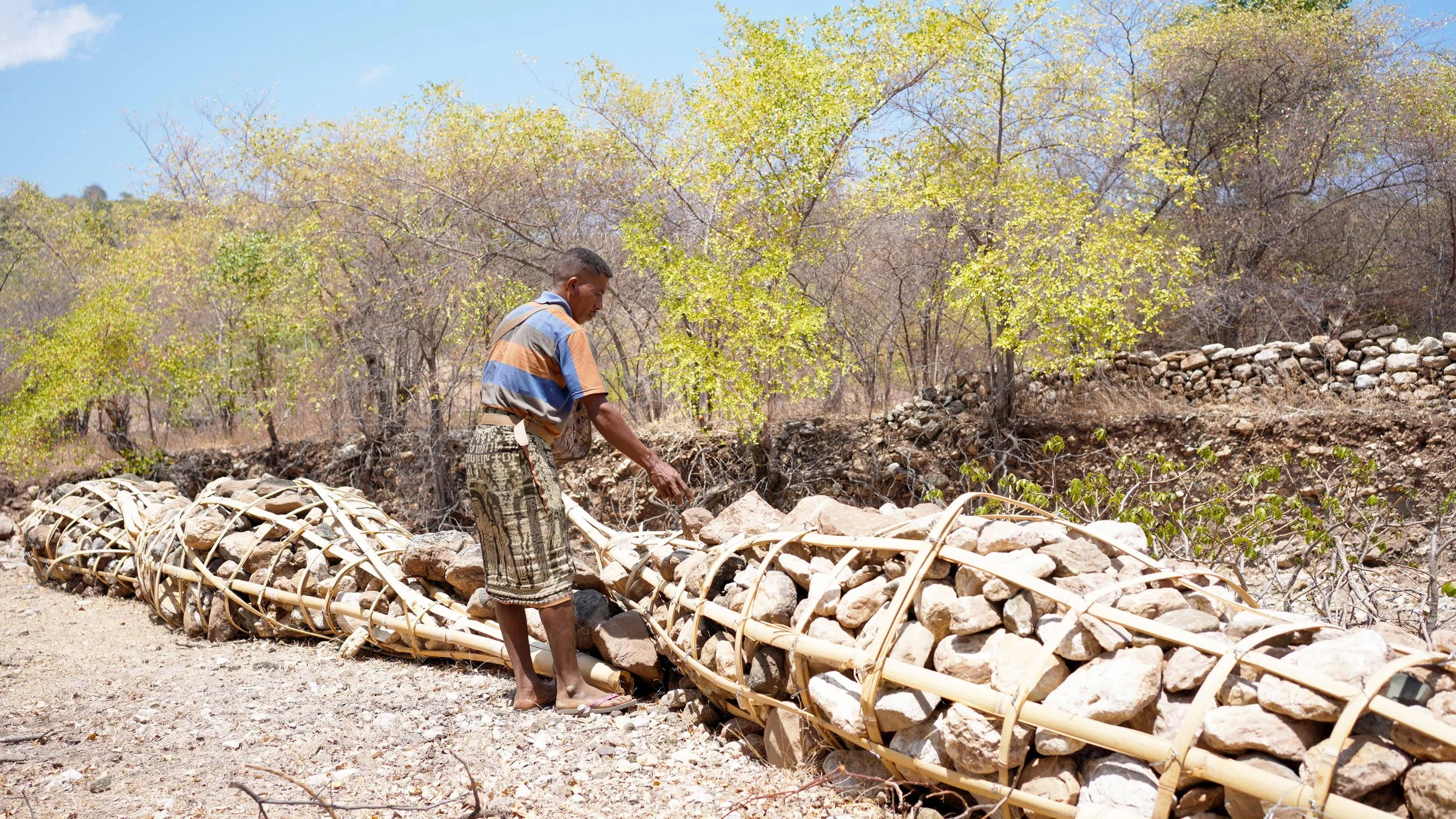
Agustinho demonstrates how the gabions work to redirect flood waters away from homes during the rainy season. IMAGE: Aderito do Rosario da Cunha Mambares
Encouraged by the results, the community continued the initiative on their own accord. “Earlier this year, in 2024, we added 15 more gabions—ten near the riverhead and five closer to the village,” he said. “We are waiting for the rainy season to test their strength, but we already believe they are working.”
The gabion project became a symbol of self-reliance and cooperation. While Oxfam and Masine Neo Oe-Cusse (MANEO), provided materials, bamboo, and logistic support, the community contributed labour—digging, collecting rocks, and installing the structures together. “Even people with disabilities and the elderly joined,” said Agustinho proudly. “Everyone helped because we all want to protect our village.”
Beyond flood control, the project expanded into water conservation and reforestation, essential for sustaining life in the hilly terrain of Suni-Ufe. “In the lowlands, we built gabions to stop floods,” Agustinho sayid “But in the hills, we started planting trees and conserving water sources.”
With MANEO’s technical guidance, the community established two water conservation sites. Oel-bubun and Oel-Nua-Ana—where they fenced off natural springs and planted trees to restore the environment. “We planted mahogany trees, java olive trees, and betel nut palms that help the springs flow again,” he says. “Now, even during the dry season, the water doesn’t dry up.”
These restored springs now provide clean water for 136 households, serving people across different hamlets. “We use the water for drinking, washing, and watering trees.”
The project also strengthened local self-help structures through Saving for Change (SfC) groups (previously known as USP groups). “Before, we had four groups,” said Agustinho. “Now we have ten. Every week, members save from 50 cents up to $50. These savings help us send our children to school or support family emergencies.”
Each group operates with small interest rates—only 50 cents for every $10 borrowed—allowing members to reinvest in farming and small businesses. “We also meet every three months with MANEO and local leaders to discuss challenges and plan future activities,” he adds. “These meetings help us strengthen our cooperation and plan for disasters together.”
Agustinho’s community has learnt that true resilience is built by working together. “When we build gabions, we protect our farms,” he said. “When we conserve water and plant trees, we protect our future. This project has brought real change. We are no longer afraid of the floods. We have water to drink, trees to protect our soil, and savings to support our families. All we need now is to keep working together.”