

Disaster preparedness starts at home
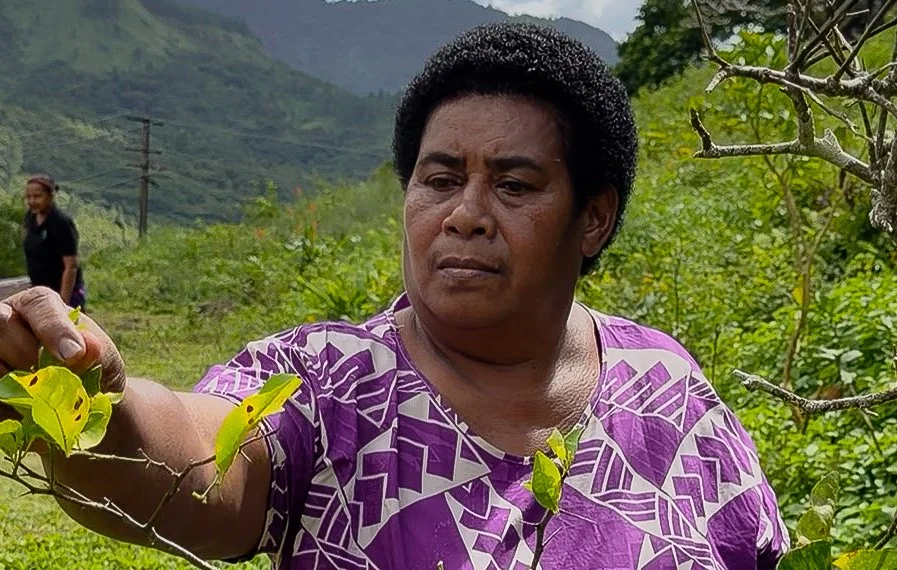
“We are now more alert as to how to take care of the vulnerable groups that need more support from us and most importantly have first-aid kit ready to assist the injured.” IMAGE: Banabas Thaggard/on behalf of Oxfam in the Pacific
The warm gentle smile of Vani Turaga reflects a journey of hard work and perseverance. At the helm of women’s leadership, the 63-year-old stands tall as the voice of women in Yaloku, Fiji. Vani is the women’s club leader and plays an active role as a Community Disaster Management Committee (CDMC) member.
The women’s club in Yaloku is seen as the backbone of CDMC and disaster preparedness efforts in the community. Vani believes it is this expectation from the community that makes women stronger: “We have a lot of responsibility on our shoulders as women, and this expectation is there because the men and leaders of this community know that we are capable of handling all disaster preparedness work,” she said proudly.
Vani acknowledged disaster preparedness support from Oxfam’s Disaster READY partner, Women in Fisheries Network (WiFN). Via Disaster READY, selected community members underwent Community Based Disaster Risk Management (CBDRM) training with Disaster Risk Reduction (DRR) kits distributed to the community at part of the training.
“The weeklong CBDRM training taught us a lot and connected all of us better. Before the training, we would evacuate without a plan. Through the CBDRM training, I learned how to better support and protect my family, especially my husband who has a disability. Now there is a plan and process in place for evacuation,” she said.
The start of any disaster preparedness starts from home says Vani: “What I learnt from the training, I make sure I share with other women in our regular women’s club meetings. It is important to share and discuss as not all of us were part of the training. When there is a disaster in the community, it is the women who prepare for and take care of everything from food, clothing, children and keeping stock of things for emergencies,” she said.
“This training taught us on how to prepare for small essential items as well. This preparation starts with us from home. We take care of our family and then we take care of the community as well. For example, we must make sure we have enough bedding, food, and water during disasters and this time we have expanded our list to ensuring we have torches, battery, radio, first-aid kit and all” she said.
Yaloku community women’s club also manages and maintains the DRR kits distributed as part of CBDRM training.
“We have to now think of how to keep that stock in place and ensure it is in good condition for use during disasters. We are glad to have some useful tools with us now and this is the first time for us to work on disaster preparedness things,” she said.
Vani described the simulation as a great learning experience. Putting learnings into practice was helpful, she says.
“It was an exciting exercise and we love it as it challenged and pushed us to do our best and test our capacity. We are now more alert as to how to take care of the vulnerable groups that need more support from us and most importantly have first-aid kit ready to assist the injured. The exercise made us think of things we didn’t think of before. We are more prepared than before surely,” said Vani.
She explains that the inclusion of women in village concerns has drastically changed over the years.
“You just got to keep pushing... and things do change overtime. We have good support from men and community leaders. We work better and closely as a community now, thanks to all this awareness and training given to us” she said with confidence.
Vani strongly emphasised for such support from NGOs continue and that it can contribute to building the resilience of family units and of communities.