

In the shadow of a volcano one community leads the way
By Lindah Peter, Program Manager Resilience & Response, Gender Equality and Inclusive Governance, CARE in Vanuatu
If you want to see what disaster preparedness looks like when it’s built from the ground up—with the people, for the people—you’ll find it in Sulphur Bay, on the eastern edge of Tanna Island in Vanuatu.
Accessible only by a road that crosses the ash plains of Mount Yasur—one of the world’s most active volcanoes—Sulphur Bay is no stranger to hardship. Volcanic ash, cyclones, landslides, contaminated water, and isolated terrain are not rare events here; they’re part of life. But with support from the Australian Humanitarian Partnership (AHP) and CARE International in Vanuatu, communities like Sulphur Bay are leading their own journey to resilience.
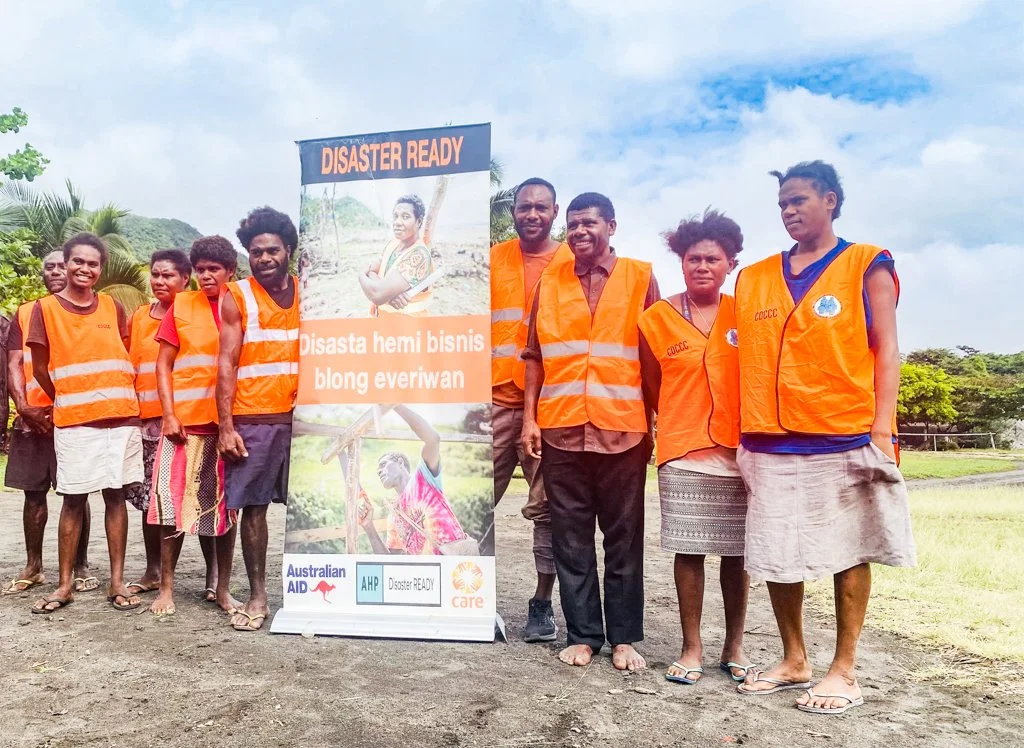
The Suphur Bay CDCCC members stand proudly with a Disaster READY banner. IMAGE: Linda Peter/CARE
Through the Disaster READY program, CARE has worked with Sulphur Bay and five other nearby communities to form and strengthen local Community Disaster & Climate Change Committees (CDCCCs)—grassroots structures that are reshaping how disasters are understood and managed at the village level. The program has helped transform disaster planning from something reactive and ad hoc into something proactive and inclusive.
"Before we were just responding and we didn’t have a plan, but now we have a plan…we did not know what a disaster is and how it affected us," says one male CDCCC member in Sulphur Bay.
The mid-term evaluation showed clear progress. Where once there were no functional CDCCCs or community disaster plans, today there are trained leaders, clear emergency procedures, and growing community awareness. Importantly, these plans aren’t just created—they will be tested through real-time simulation exercises and supported by household-level contributions to emergency response funds. Sulphur Bay’s CDCCC even created its own local emergency fund by collecting small donations from each household—evidence of both ownership and innovation.
But resilience here isn’t just about logistics—it’s about inclusion.
The program has focused on ensuring women have a seat at the table in disaster decision-making. Through initiatives like Finding Your Voice training, women who were once too shy to speak in public are now helping lead emergency planning discussions. One female CDCCC member shared: “In the past, women were too shy to speak up in public spaces, but with training, it’s helped to build our confidence.”
People with disabilities—too often overlooked in traditional disaster responses—are also being included in meaningful ways. CARE’s collaboration with the Vanuatu Society for People with Disability (VSPD), the Tafea Disability Desk, and Osnalmok, an organisation of persons with disabilities, has helped gather critical disability data across Tanna. This data allows for disaster responses that consider the specific needs of people with disabilities—needs that are often invisible without intentional outreach.
"When we have the data, we can conduct activities that help people, but we need the data to conceive change at the community level,” explains Maxwell Narak from the Tafea Disability Desk.
In addition to empowering local voices, the program has helped boost the visibility and capacity of Vanuatu’s disability sector. Partners like VSPD have expanded into new areas, built stronger relationships with local leaders, and supported the mainstreaming of disability inclusion across all levels of preparedness.
As of June 2025, over 900 people have been reached through the program—well beyond the original target of 360—including 54 people with disabilities. Of these, 21 are women, reinforcing the program’s commitment to gender and disability inclusion.
As CARE and its partners enter the final 18 months of implementation, the focus will shift to refreshing trainings, mentoring local leaders, finalising community and Area Council disaster plans, and rolling out community-wide simulations and awareness campaigns. These next steps will build on momentum that is already transforming the way Tanna Island responds to crises.
For the people of Sulphur Bay and beyond, the message is clear: disaster preparedness isn’t about waiting for help—it’s about knowing what to do, who to call, and how to act. And thanks to the partnership between Vanuatu communities, local disability organisations, and the people of Australia through DFAT and the AHP, these communities are proving that no one needs to be left behind.